:quality(80))
Most Shopify stores send abandoned cart emails and SMS but don’t actually know what revenue those messages generate.
SMS abandoned cart for Shopify: how to track revenue, not just clicks (Australia guide)
Most Shopify stores are sending abandoned cart emails. Some are sending SMS reminders too. But here is the real question: can you see exactly how much revenue those messages are generating?
High open rates do not pay the bills. Click-through rates do not grow your store. Revenue does.
Shopify abandoned carts represent some of your highest-intent customers. They reached the checkout. They were close. But if your SMS strategy is just set-and-forget, you could be sending messages without knowing whether they are actually converting.
SMS abandoned cart marketing for Shopify is not about blasting reminders. It is about sending the right message, at the right time, and being able to track the revenue it drives.
What is SMS abandoned cart marketing?
SMS abandoned cart marketing is the practice of sending a text message to a shopper who added items to their cart but left without completing the purchase. The message is triggered automatically by your Shopify store, sent through an SMS platform, and timed to catch the shopper while the intent to buy is still fresh.
Unlike a broadcast campaign, abandoned cart SMS is one-to-one. It references the specific customer, their specific cart, and creates a direct path back to checkout. That combination of timing, personalisation, and channel is why cart recovery SMS consistently outperforms email in recovery rate.
The key word in all of this is 'recovery'. Not 'sent'. Not 'opened'. Recovery means a completed order. That is the only metric that matters for your store's revenue line.
Why customers abandon their cart in Shopify.
The Baymard Institute puts the average documented cart abandonment rate across e-commerce at around 70%. For Australian Shopify merchants, the reasons are consistent:
Unexpected shipping costs revealed at checkout.
Required account creation before purchase.
A checkout process that felt too long or asked for too much.
Payment method not available.
The shopper was browsing, not ready to commit, and got distracted.
Price comparison with another store.
The first three are fixable at the store level. The last three are where SMS recovery earns its place. A well-timed message recovers the shopper who was genuinely interested but simply left at the wrong moment.
Why SMS works better that email for cart recovery.
Email is not dead for cart recovery, but it has real structural disadvantages compared to SMS for this specific use case.
| Factor | SMS vs email for abandoned cart |
|---|---|
| Open rate | SMS: 95%+ open rate, most within 3 minutes. Email: 20–30% open rate, often read hours later. |
| Deliverability | SMS delivers directly to the lock screen. Email competes with filters, tabs, and promotional folders. |
| Friction to act | One tap from an SMS to checkout. Email often requires unlocking, finding, clicking, then loading. |
| Personalisation | Both can personalise, but SMS feels more direct and less like a broadcast. |
| Consent requirement | Both require consent under Australian law. SMS consent rules are stricter (always express). |
| Cost | SMS costs more per message than email. The ROI justification requires meaningful AOV. |
SMS is not a replacement for email in cart recovery. It is a complement. The combination of both channels, timed and sequenced correctly, recovers more revenue than either alone.
Does SMS cart recovery actually work?
Yes, when the conditions are right. The recovery rate for SMS abandoned cart flows varies by store, but a well-configured flow in a medium-to-high AOV Shopify store consistently returns 5–15% of abandoned carts as completed orders.
The more important question is not whether it works in general. It is whether you can see it working in your store. That is where most SMS tools fall short.
Open rate tells you a message was delivered. Click rate tells you someone tapped the link. Neither tells you whether an order was placed. Revenue attribution, specifically the ability to connect a completed Shopify order back to the SMS that preceded it, is the measurement that actually matters.
Example ROI calculation using Kudosity.
Here is a realistic example for an Australian Shopify store using Kudosity's cart recovery flow, with revenue attribution active.
| Your Numbers | The return |
|---|---|
| Average order value (AOV): $120 AUD | Weekly revenue recovered: $1,200 AUD |
| Abandoned carts per month: 400 | Monthly revenue recovered: $4,800 AUD |
| SMS recovery rate: 10% | ROI = 300:1 |
| Recovered orders/carts per month: 40 | Payback period: First recovered cart |
| SMS cost per month: $16 AUD |
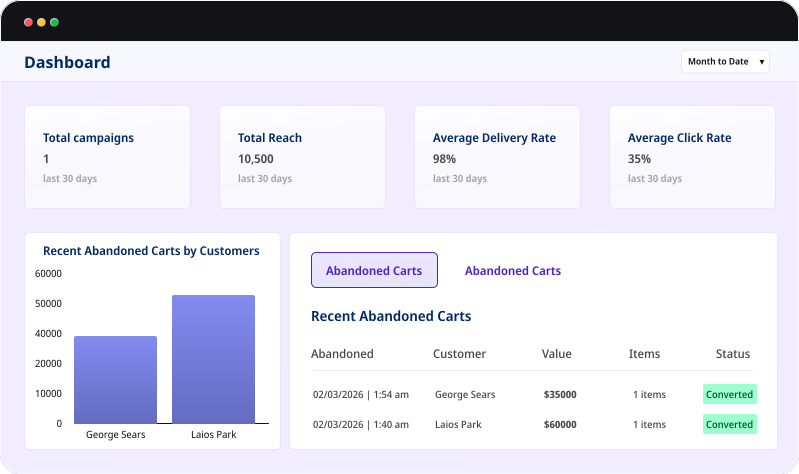
Example dashboard
When SMS makes financial sense, and when it doesn't.
SMS cart recovery is not the right tool for every store. The maths only work when the revenue per recovered cart is meaningfully higher than the cost to send and manage the flow.
| Store type | SMS cart recovery — fit assessment |
|---|---|
| High-margin products | Strong fit. Every recovered order contributes real margin, not just revenue. |
| Medium to high AOV ($80 AUD+) | Strong fit. A $3–5 AUD SMS cost is trivially small against a $120+ order. |
| Repeat customer businesses | Strong fit. The lifetime value of recovery is compounded across future order |
| Low AOV products (under $40 AUD) | Weak fit. Recovery revenue may not cover SMS cost plus fulfilment. |
| High-frequency, low-margin stores | Weak fit. Volume does not compensate for margin compression. |
| Email-only audiences | Consider email first. If open rates are high and recovery is already working, SMS may be redundant for your specific list. |
Best SMS abandoned cart message templates for Shopify.
The following templates are written for Australian Shopify merchants. Adapt the brand name, product references, and tone to match your store.
Each templates serves a different commercial purpose, choose based on your margin position and relationship with your customer.
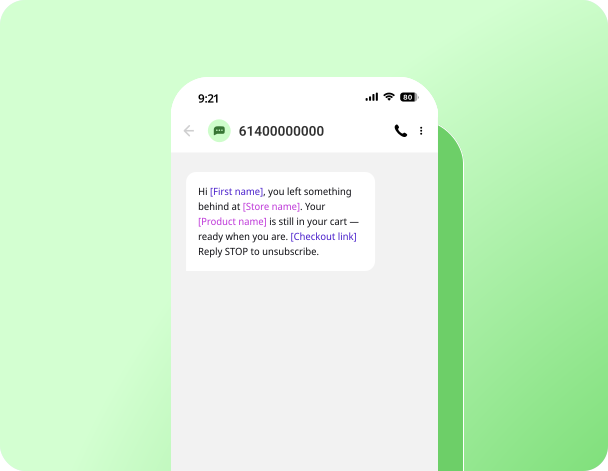
No-discount reminder
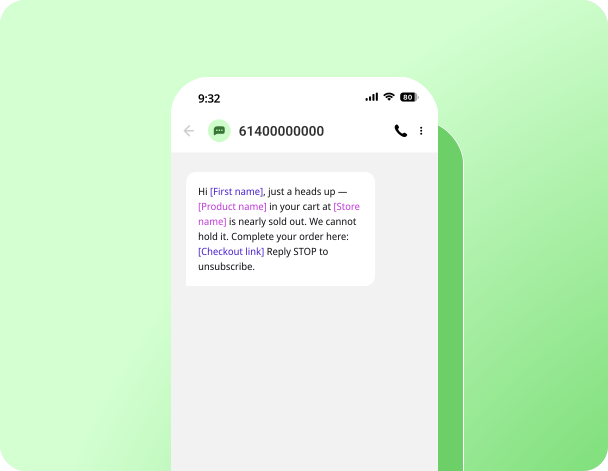
Urgency message
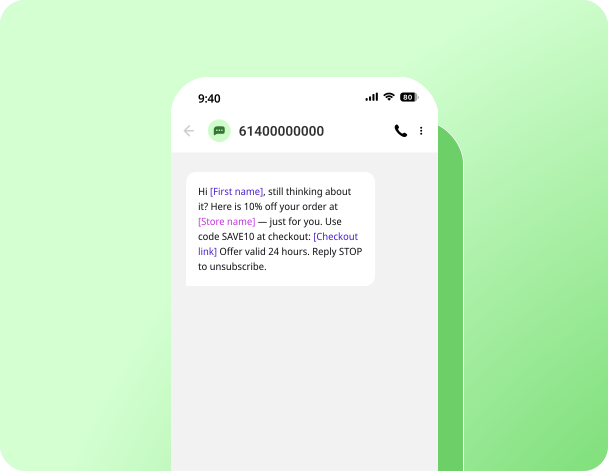
Incentive message
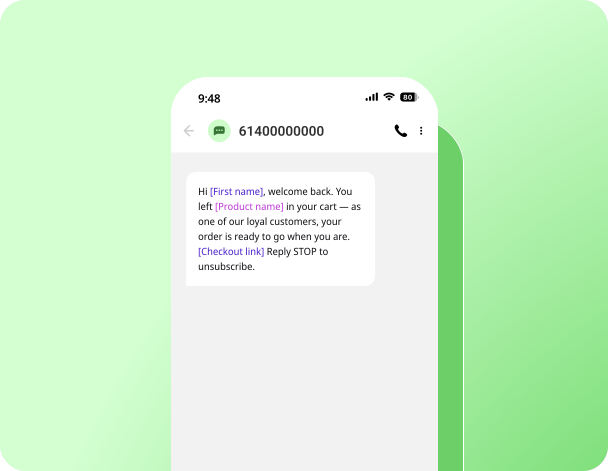
VIP or repeat customer version
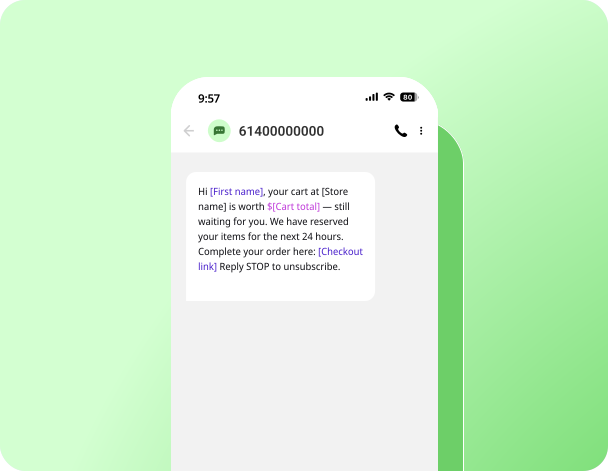
High cart value version
Standard SMS is 160 characters. Messages longer than 160 characters are sent as multiple parts and billed accordingly. Keep messages short, one clear action, one link, one opt-out line.
Personalisation tokens like [First name] and [Product name] count toward your character total once populated. Always test before sending a flow live.
Advanced segmentation for Shopify SMS abandoned cart.
Sending one cart recovery message to every abandoning customer is the baseline. Segmentation is where the real improvement in recovery rate and margin efficiency comes from. The goal is to match the message to the context of the customer, not just the fact of the abandoned cart.
High cart value:
Customers with carts over $150 AUD have demonstrated strong purchase intent. They are worth a more personalised approach and, if needed, a specific incentive sized to their cart value rather than a flat percentage.Segment: Shopify customers where cart total is greater than $150 AUD. Message approach: reference the cart value, offer a reserved-items message, and consider a time-limited free shipping offer rather than a percentage discount.
First-Time visitors:
A first-time visitor who reaches checkout has cleared a significant intent threshold. They are unfamiliar with your brand, which means trust is the primary barrier, not price. The recovery message should reassure, not pressure.
Segment: Shopify customers with zero previous completed orders. Message approach: no discount, no urgency. Lead with your returns policy, your customer support availability, and a clear path back to checkout.Returning customers:
A returning customer who abandons their cart is usually a timing or friction issue, not a consideration issue. They already trust the brand. The recovery message should be brief, warm, and assume the sale is still there.Segment: Shopify customers with one or more previous completed orders. Message approach: template 4 (VIP version). No incentive needed in the first message. If they do not convert, a small loyalty reward in a follow-up message is appropriate.
Geography-based segmentation:
Australian states have different public holidays, seasonal buying patterns, and in some cases different product relevance. If your store sells seasonally variable products, state-level segmentation can improve timing and relevance.
Example: customers in Victoria abandoning carts in the lead-up to Melbourne Cup weekend may respond differently to a timing-based message than customers in Queensland. If you have enough volume by state to test this, it is worth building.
Category-based segmentation
Customers abandoning high-margin product categories warrant different treatment than those abandoning clearance items. If you have categories where margin supports a recovery incentive and others where it does not, segment accordingly.
Composite segments
The most commercially useful segments combine multiple criteria.
Example: Australian customers who have placed two or more previous orders and have spent over $200 AUD in total lifetime value. This segment represents your highest-value recoverable customers and deserves a tailored message, a specific incentive, and potentially a follow-up call from your customer service team for very high cart values.
Kudosity supports audience filters that allow you to build these composite segments directly from your Shopify customer data.
When not to use SMS for abandon cart.
SMS cart recovery is a tool with real constraints. Using it in the wrong context costs you money, opt-outs, and customer trust.Scenario Why SMS is the wrong choice here Low AOV products (under $40 AUD) The maths do not work. At a 10% recovery rate, 100 abandoned carts recovers $400 in revenue. SMS costs $25–$40 per 100 sends. The margin left after product cost and SMS cost may not justify the investment. No verified consent on file You cannot legally send marketing SMS in Australia without express consent. If your current list was not built with an explicit SMS opt-in, do not send. Rebuild the list correctly first. Very high send frequency If customers are already receiving multiple messages from you across channels each week, adding SMS cart recovery can tip the balance into over-communication. Monitor opt-out rates. Over-saturated promotional environment If your store sends EOFY, Black Friday, mid-season sale, and weekly promotional SMS, cart recovery messages can get lost in the noise. Audit your overall send frequency before adding another automated flow. Products requiring complex consideration High-consideration purchases (furniture, large appliances, B2B products) often involve multiple decision-makers or longer research cycles. A single recovery SMS is unlikely to close the loop — it may be more effective to route these to a follow-up call or a longer email nurture sequence. Key metrics to track for Shopify SMS marketing.
Tracking the right metrics is the difference between knowing your SMS is working and guessing. Each metric below tells you something specific about a different part of the flow.
Delivery rate: is the percentage of messages that were successfully delivered to the recipient's handset, as confirmed by the carrier. A delivery rate below 90% usually indicates list hygiene issues — invalid numbers, ported numbers, or numbers that have been deactivated.
What to do: run a number validation pass on any list you have not cleaned in the past six months. Kudosity shows delivery rate at the campaign level so you can identify problems before they compound across multiple sends.Click-through rate (CTR): measures the percentage of delivered messages where the recipient tapped the link. For abandoned cart SMS, a CTR of 15–25% is a reasonable benchmark for a well-targeted, consented list.
CTR tells you whether your message is compelling enough to drive action. If CTR is low but delivery rate is healthy, the message itself is the problem, test a different first line, a different offer or a different timing.
Conversion rate: is the percentage of link clicks that resulted in a completed Shopify order within the attribution window. This is where click-tracking and revenue attribution part ways. High CTR with low conversion rate usually means the link led to checkout but friction in the purchase flow stopped the order from completing.
What to look for: if CTR is 20% but conversion is 2%, the checkout experience is losing the customer after they click. Investigate checkout completion rates in Shopify analytics.Revenue attribution: is the total dollar value of completed Shopify orders that can be directly connected to an SMS send within the attribution window. This is the metric that tells you whether your SMS programme is paying for itself.
Kudosity pulls attribution data directly from Shopify's order records, matched to the SMS that preceded the order within a defined window. The campaign report shows total revenue attributed, broken down by campaign.
Attribution window: Kudosity's attribution window for cart recovery is 48 hours by default. This means an order completed within 48 hours of the SMS send is counted as attributed to that message.
Get ready for Australia’s SMS Sender ID Registry
From July 2026, Sender ID registration will be required. ACMA’s final steps are still in progress, but Kudosity will keep you informed and help you be ready when registration opens.
FAQs
Any customer who has provided their mobile number and given explicit consent to receive SMS marketing from your store. In Australia, consent must be express consent, a customer providing their phone number to receive a purchase receipt does not constitute express consent for marketing messages. You need a dedicated opt-in step, such as a checkbox at checkout or a sign-up form.
The Kudosity Shopify app connects your SMS campaigns directly to Shopify's order data. This means you can see revenue attribution, not just clicks, for every campaign you send. Most SMS tools show you delivery and click rates. Kudosity shows you the dollar value of what those messages actually recovered. For abandoned cart specifically, you can see conversions, revenue, cost per acquisition, and ROI from a single dashboard view.
For most stores, one to two messages is the right answer. A first message sent 30–60 minutes after abandonment, and an optional second message sent 24 hours later if the cart is still abandoned. Beyond two messages, opt-out rates increase and the incremental recovery rate drops significantly. If you want to extend the sequence, use email for later-stage follow-up rather than additional SMS.
Between 9am and 8pm in the recipient's local time. For timing within that window, mid-morning (10am–12pm) and early evening (5pm–7pm) tend to generate the highest CTR for retail SMS. For abandoned cart specifically, a 30-minute trigger window catches the customer while the purchase intent is still active.
For speed and open rate, yes. SMS is opened within minutes, email is often read hours later or not at all. For cost and volume, email wins, it is substantially cheaper per send. The most effective approach is both channels in sequence: SMS for the immediate recovery window, email for the 24-hour and 72-hour follow-ups. This maximises recovery rate without over-spending on SMS sends.
Yes, always. Under the Spam Act 2003, all commercial SMS marketing in Australia requires consent. For SMS specifically, ACMA recommends express consent, meaning the customer actively opted in through a specific action such as ticking a checkbox or submitting a sign-up form. A completed purchase does not constitute consent for future marketing messages. If you are not currently capturing explicit SMS opt-ins at checkout, this is the first thing to fix before running any SMS campaign.
A well-configured SMS abandoned cart flow for an Australian Shopify store with a consented list and AOV above $80 AUD will typically recover 5–15% of abandoned carts. The wide range reflects the significant variation in list quality, message timing, product type, and whether express consent was collected correctly. Stores with very clean lists, high AOV, and repeat customers tend to sit at the top of that range.
The cost depends on the platform and how you send. Kudosity's Shopify app is free to install. You pay per message sent, with no monthly minimums. For a flow sending to 100 abandoned carts per week, the weekly SMS cost would typically be $25–$40 AUD. Against a recovery rate of 10% and an AOV of $120, that produces $1,200 in weekly recovered revenue, a return of 30–40x the send cost.
Yes, and this is generally the most effective approach. A combined sequence might look like: SMS at 30 minutes (immediate, high-open-rate recovery window), email at 2 hours (for customers who did not act on the SMS), and a second email at 24 hours with an optional incentive. This sequence reaches customers through two channels without over-saturating either, and lets the SMS handle the time-sensitive window while email handles the longer consideration tail.
:quality(80))
:quality(80))
:quality(80))