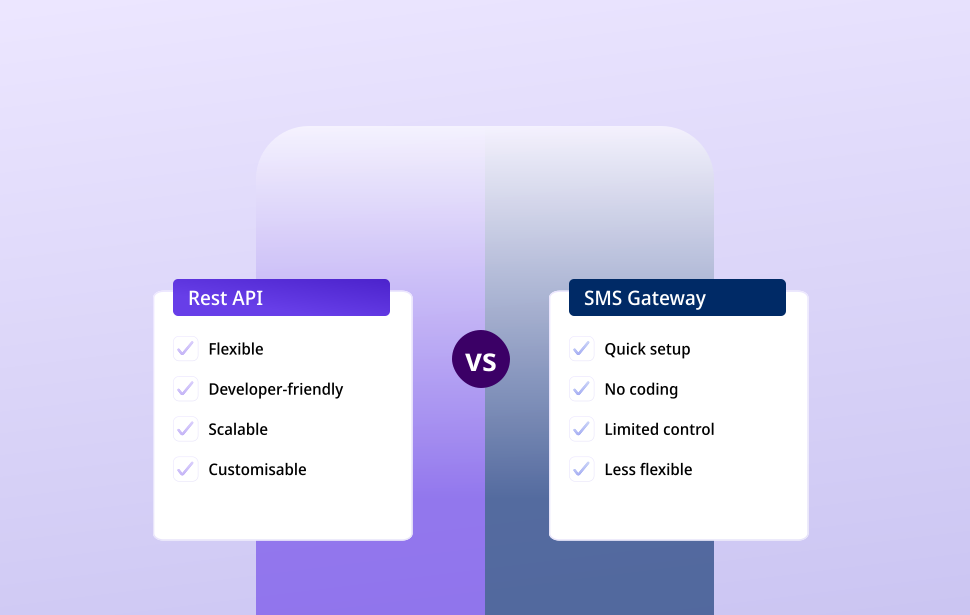
REST API vs SMS gateway: which is better for sending SMS?
If you are comparing REST API vs SMS gateway options, the first thing to clarify is that they are not always direct alternatives.
An SMS gateway is the underlying infrastructure that connects your software to mobile carrier networks. A REST API is one way to connect with that infrastructure, and SMPP another. That distinction matters, because the right setup depends less on labels and more on what your business actually needs the messaging layer to do.
For some teams, connecting through a REST API is the practical choice. It's easier to integrate, easier to maintain, and well-suited to automated workflows. For others, especially at higher send volumes, connecting directly to the gateway through SMPP may offer more throughput and tighter control.
The best decision usually comes down to four things:
how your systems are built
how much SMS volume you send
how much control you need over performance, routing, and integration
your technical capability and development resourcing
What's an SMS gateway?
An SMS gateway is the infrastructure that enables messages to move between software applications and mobile networks.
In practical terms, it acts as the bridge between your system and downstream aggregators or carriers that actually deliver the SMS. Without that gateway entry point, your platform cannot reliably send or receive messages.
Businesses can access SMS Gateways in different ways. They might use a platform interface, connect through a REST API, or establish a direct protocol connection through an SMS gateway.
What's a REST API in SMS?
In an SMS environment, a REST API gives your application a structured way to send requests to the gateway.
That request might tell the platform to send a message, return a delivery report, check message status, or handle replies. Because REST APIs use standard HTTP methods and common languages like JSON, they are generally easier for development teams to adopt than telecom-specific protocols like SMPP.
This is one reason REST API-led messaging is widely used across ecommerce, SaaS, customer service, logistics, and internal operations. It lets teams add SMS into existing systems without needing deep telecom expertise.
For many businesses, this makes a REST API the most practical path for SMS gateway integrations. It works well when SMS needs to sit inside broader workflows rather than operate as a standalone channel.
REST API vs SMS gateway: the real difference
When comparing REST API vs SMPP for SMS gateway access, the real question is not which one is better in theory. It's which access method fits your operating model.
REST API
A REST API is usually the better fit when you need to:
connect SMS to third party applications, CRM, booking systems, or ecommerce platforms
trigger messages based on customer or system events
manage delivery reports and replies through standard web workflows
launch faster without building around telecom-specific protocols
Leverage AI tooling, including MCP servers and Kudosity plugins or extensions for agents
Direct SMS gateway access via SMPP
Direct gateway access is typically better suited to businesses that:
send very high volumes of SMS on a regular basis
need persistent connections for faster throughput
want more direct control over message handling
already have engineering capability to manage a more technical setup
So while the phrase REST API vs SMS gateway sounds like a side-by-side product comparison, in practice it's more accurate to think about access layers. REST APIs offer a simpler interface, while SMPP is a more direct protocol. Both can sit on top of the same gateway infrastructure.
When a REST API makes more sense
A REST API is often the right choice for businesses that want to make SMS part of a larger workflow.
For example, you might want to send order confirmations, one-time passcodes, appointment reminders, payment prompts, or support updates based on real-time events inside your own systems. In those cases, REST APIs give developers a straightforward way to integrate messaging logic without adding unnecessary complexity.
It also works well when speed of implementation matters. Most development teams already know how to work with HTTP requests, authentication, and JSON payloads. That lowers the barrier to adoption and makes ongoing maintenance easier.
For many businesses, especially those earlier in their messaging maturity, this is the most efficient approach to SMS gateway integration. It gives enough control for meaningful automation, while keeping implementation manageable.
When SMPP and direct SMS gateway access makes more sense
There are use cases where a direct SMPP connection to the gateway is the better option.
This typically happens when messaging becomes a core operational function rather than a simple API call. As volume increases and delivery timing becomes more critical, the overhead of a REST API can start to limit performance. In these cases, businesses often look at SMPP.
If you are asking how does SMPP work, it comes down to connection type. Instead of sending a new request for every message, SMPP maintains a persistent connection between your system and the SMS gateway. That connection stays open, reducing processing overhead and allowing messages to flow faster and more consistently, particularly at scale.
This approach is most relevant for businesses that:
send high volumes of messages on a daily basis
run time-sensitive messaging workflows where delays are not acceptable
need greater control over throughput and delivery handling
have the technical capability to manage a more specialised SMS gateway integration
It can also be a fit for businesses managing their own sender infrastructure, including virtual mobile numbers or other messaging-enabled numbers.
For these use cases, SMPP can deliver clear performance advantages. However, it requires a more involved setup and ongoing management, so the right fit depends on your volume, architecture, and internal resources.
How does SMPP work in practice?
A practical way to understand how SMPP works is to look at how the connection is handled. Instead of sending a new request for every message, your platform opens a persistent session with the SMS gateway, and messages flow through that connection continuously.
This is the key difference in the REST API vs SMS gateway discussion. A REST API creates a new request each time, which adds processing overhead. SMPP keeps the session live, reducing that overhead and supporting faster, more consistent throughput when message volumes are high.
That performance gain comes with trade-offs. SMPP requires you to manage the connection directly, including session handling and recovery if the connection drops. It also means more responsibility sits with your team rather than being abstracted through a simpler SMS gateway integration.
For teams that need scale and control, that trade-off can make sense. For others, particularly where volumes are lower or speed is less critical, a REST API is often the more practical option.
Can you use both?
Yes, and many businesses do.
A modern messaging setup does not always require a permanent choice between REST and direct gateway access using SMPP. Some businesses begin with a REST API because it's quicker to implement and easier to fit into existing workflows. As volume grows, or as performance requirements become more demanding, they may introduce SMPP connectivity for specific use cases.
That flexibility matters. It means your messaging setup can evolve with the business rather than forcing a full rebuild later.
Which option is right for your business?
If your goal is to automate customer communication, integrate SMS into existing systems, and move quickly, a REST API is usually the right place to start.
If your business sends very large volumes and has the development resources to support a more direct telecom-grade setup, gateway access through SMPP may be the better fit.
The decision is not just about choosing the most technical option. It's about choosing the method that aligns with your:
application
workflow
send volume
internal capability
commercial priorities.
Kudosity supports both REST API integration and SMPP connectivity, so businesses can choose the model that fits now and adjust as requirements change. For a clearer view of commercial fit, it also helps to review the available pricing options alongside technical requirements.
FAQs
No. An SMS gateway is the underlying infrastructure that connects to carrier networks. An API is one way to access that infrastructure. A gateway may support multiple connection methods, including REST and SMPP.
For very high-volume use cases, SMPP is generally faster because it uses a persistent connection. REST APIs are still highly effective, but they are usually chosen for ease of integration and workflow flexibility rather than maximum throughput.
It depends on how you access it. REST APIs are typically easier for most development teams to work with. Direct SMPP connectivity requires more specialised implementation and operational oversight.
SMPP is a telecommunications protocol, allowing software applications to communicate directly with SMS gateways through persistent sessions. It's a binary protocol with requests consisting of ones and zeroes that're organised into a structured format.
On the other hand REST API's use standard HTTP requests and are generally easier to implement in modern applications.
Yes. REST APIs can support significant volume when implemented well. At very high throughput levels, though, direct SMPP access may be more efficient.
For most businesses, connecting via Kudosity's REST API is the more practical choice because it fits more easily into applications and workflows. For businesses with very high message volumes or more advanced routing requirements, SMPP may be more suitable.
Yes. Kudosity supports both approaches, which gives businesses flexibility to start with the model that fits their current needs and scale over time.
:quality(80))
:quality(80))
:quality(80))