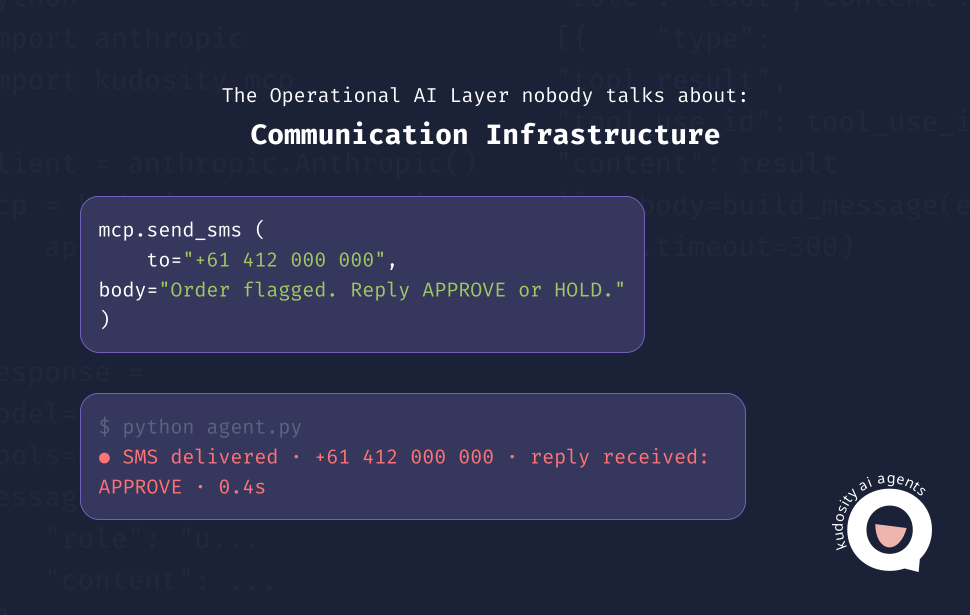
The operational AI layer nobody talks about: Communication Infrastructure
In the first post in this series, we explored why MCP alone doesn't close the gap between AI that can act and AI that organisations can trust. MCP standardises how AI agents connect to tools and data sources, but once those agents start operating in real workflows, interacting with real business processes, a new set of requirements emerges. Requirements that have nothing to do with tool access and everything to do with human coordination.
This post explores that coordination layer: what it involves, how it works in production, and why it is now a core part of the operational AI stack.
The gap most AI stacks don't address
When teams describe their AI infrastructure, they typically list the same components: a foundation model, an orchestration framework, a retrieval layer, and a set of tools or integrations connected through something like MCP. That stack can plan, retrieve, reason, and execute across complex multi-step workflows.
What it typically can't do is tell a human what just happened, wait for a response, or route an urgent situation to the right person before continuing. That's not a gap in model capability. It's a gap in communication infrastructure.
As AI agents take on higher-stakes tasks, processing transactions, modifying records, triggering downstream systems, the question that matters most in production shifts from "can the agent do this?" to "does the right person know what the agent did, and can they intervene if they need to?" Answering that question requires a layer most AI stacks don't yet have.
Quick definition: AI communication infrastructure
AI communication infrastructure refers to the messaging, escalation, approval, and coordination systems that allow AI workflows to interact safely and reliably with humans, notifying the right people, at the right time, with delivery confirmation and a full audit trail.
Four communication patterns in production AI
Operational AI communication isn't a single thing. In practice, it takes four distinct forms, each serving a different function in the workflow.
Proactive notifications alert a human operator when an agent has completed an action, reached a defined threshold, or detected a condition that warrants attention. A notification doesn't require a response, it closes the informational loop between what the AI has done and what a human knows. In e-commerce, this might be an alert to a fulfilment manager when a high-value order is flagged by a fraud detection agent and held for review before dispatch.
Confirmation messages function like delivery receipts within the system. They don't just signal that a message was sent, they confirm it was received and, where two-way messaging is enabled, that the recipient has acknowledged it. In operational AI systems, this distinction matters: an unacknowledged confirmation is a signal that fallback handling or re-escalation may be needed.
Escalation workflows are the most operationally sensitive communication pattern.
They occur when an AI system reaches a decision boundary it is not authorised to cross autonomously. That might include an approval threshold, a compliance checkpoint, or a situation where the operational risk is too high for fully automated action.
At that point, the workflow pauses and routes the situation to a qualified person for review.
If no response is received within a defined timeframe, the escalation may route to a secondary contact or trigger a fallback action. This is not simply a notification. The workflow depends on the human response to continue.
Customer-facing outbound messaging is the pattern most relevant to customer-experience teams. In customer-facing AI deployments, the agent doesn't just act, it communicates. Status updates, appointment confirmations, refund notifications, and service alerts all require reliable, delivery-confirmed messaging with full audit visibility. Kudosity's SMS API and WhatsApp messaging are built for exactly this pattern, delivery-confirmed, audit-logged, and integrated directly into operational workflows.
Why scale makes this infrastructure question urgent
Gartner projects that by 2029, 70% of enterprises will deploy agentic AI as part of IT operations, up from less than 5% in 2025. As that deployment scales, so does the blast radius of silent failures: agents acting without notifying anyone, escalations that never reach the right person, approvals that time out without fallback handling.
McKinsey's 2025 State of AI report found that regular generative AI use across business functions rose from 65% in 2024 to 71% in 2025, a signal that organisations are moving from experimentation to operational deployment faster than their governance infrastructure is being built.
At scale, silent failures become operational failures. Delivery-confirmed, audit-logged, latency-aware messaging stops being a convenience and starts being a reliability requirement once agents are operating across real business workflows.
The gap isn't between what AI agents can do and what organisations want them to do. It's between what agents do and what the people responsible for those agents can see.
The regulatory dimension
Human oversight of AI systems is becoming a formal compliance requirement in multiple jurisdictions.
Article 14 of the EU AI Act requires high-risk AI systems to support effective human oversight during operation. Article 26 further requires deployers to assign oversight responsibilities to appropriately trained individuals and retain relevant event logs.
In practice, this means the people responsible for oversight must be notified reliably, receive escalation requests in time, and have their responses logged within the workflow itself.
That is fundamentally a communication infrastructure requirement.
The NIST AI Risk Management Framework makes a similar case in the US context, identifying human oversight and accountability mechanisms as core requirements for trustworthy AI deployment.
This is no longer simply a governance discussion. It is an infrastructure requirement.
What "trust" actually means for operational AI
In operational AI systems, trust has a practical definition.
The humans responsible for the system must be able to answer three questions at any time:
What did the system do?
Who was notified?
What was the response?
Answering those questions requires delivery-confirmed messaging, timestamped audit logs, escalation tracking, and two-way communication between humans and operational workflows.
Kudosity provides the operational communication layer for AI workflows through delivery-confirmed SMS and WhatsApp messaging, two-way reply handling, audit logging, escalation workflows, webhooks, and API integrations designed for production systems.
These workflows integrate directly with AI agent infrastructure via APIs or MCP servers, enabling reliable human coordination, escalation handling, and delivery visibility within operational AI environments.
Communication infrastructure and MCP: complementary, not competing
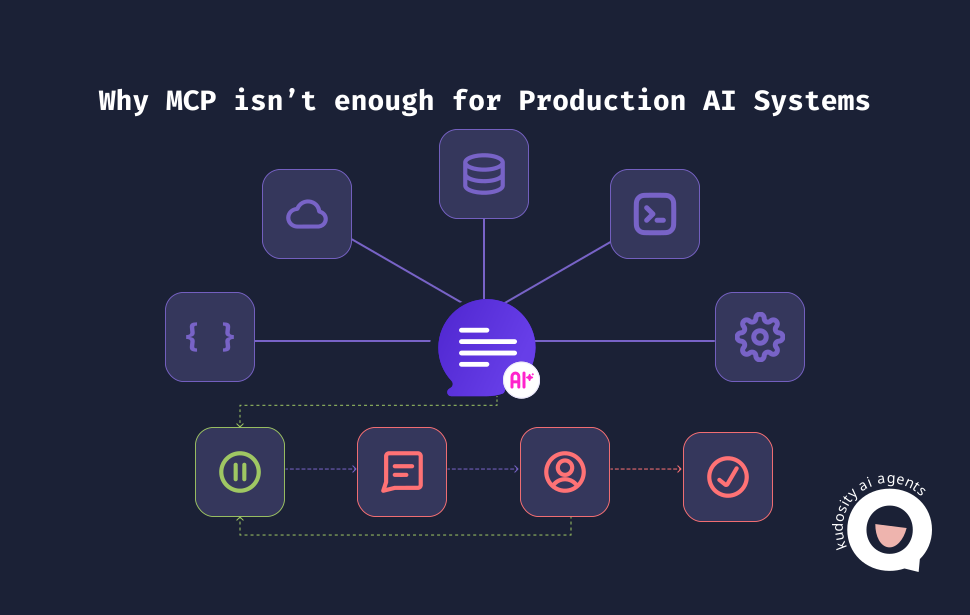
MCP and communication infrastructure are complementary layers in the same production AI stack. MCP connects agents to tools and data. Communication infrastructure connects agents to people. Both are necessary, and in regulated, high-stakes environments, both are becoming requirements rather than choices.
A production AI workflow might use MCP to connect an agent to a Shopify store, fraud detection tool, or order management system, and Kudosity's communication infrastructure to notify a fulfilment manager via SMS when a high-value order is flagged for review before dispatch. The MCP layer handles the tool connections. The communication layer handles the human coordination.
The Kudosity Claude integration is a practical starting point for teams building Claude-based AI workflows that need operational messaging built in from the start.
Explore the Kudosity developer portal
Integrate SMS and MMS into your applications with our flexible API. Our REST SMS API allows seamless integration of SMS capabilities into your applications, whether you're launching a new app or enhancing an existing one.
FAQs
Operational AI systems typically generate four types of messages: proactive notifications (informing a human that an action has been taken or a threshold reached), confirmation messages (verifying delivery and acknowledgement), escalation requests (pausing workflow execution pending human review or approval), and customer-facing outbound messages (status updates, alerts, and confirmations sent directly to end users). Each type has different delivery, latency, and audit requirements and each requires a communication infrastructure capable of handling them reliably at scale.
A notification is informational, it tells a human what an AI system has done without requiring a response. An escalation is a structured handoff: the AI has reached a point where autonomous action is not appropriate, and a qualified person must review and respond before the workflow continues. Escalations require delivery confirmation, response tracking, and a time-bounded decision window. If no response is received within that window, the escalation must route to a secondary contact or trigger a fallback action. Getting this distinction right is critical to building AI workflows that are both efficient and safe.
Article 14 of the EU AI Act requires high-risk AI systems to be designed for effective human oversight. Article 26 requires deployers to retain event logs for a minimum of six months. Delivery-confirmed messaging with full audit trails directly satisfies both requirements, creating a timestamped record of who was notified, when, and how they responded. Without this infrastructure, compliance teams have no verifiable evidence that oversight checkpoints functioned as intended, which creates both operational and legal risk.
Yes. AI agents can trigger SMS delivery through messaging APIs integrated into their tool stack, or via an MCP server. The key operational requirement is that the messaging layer returns delivery confirmation back to the agent, so the workflow knows whether the message was received and can escalate or retry if it was not. Kudosity's SMS API is built for exactly this pattern, with delivery receipts, two-way reply handling, and audit logging. See the Kudosity developer platform, including API references, SMS implementation guides, webhook documentation, MCP integrations, and operational messaging workflows for AI systems.
:quality(80))
:quality(80))