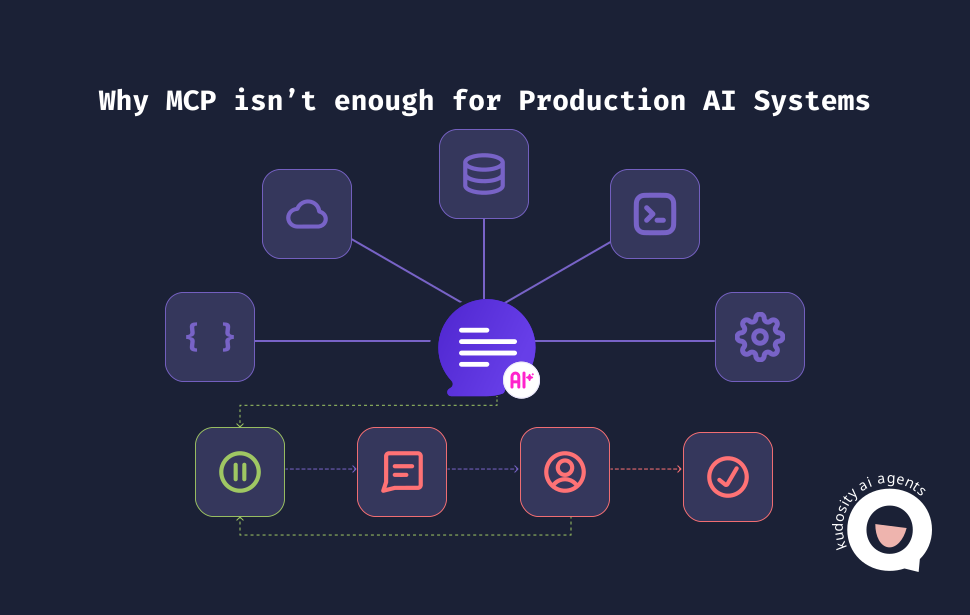
Why MCP isn’t enough: the Communication Layer your AI Agents are missing
Model Context Protocol (MCP) is changing how AI systems interact with tools, APIs, and operational systems.
Imagine an AI agent that executes a financial transaction, detects an anomaly, and needs a human sign-off before proceeding. It queries the right APIs. It has all the context it needs. But no one finds out until it’s too late because there was no messaging layer to tell them.
That’s the gap MCP doesn’t close.
MCP, originally developed by Anthropic and now governed by the Linux Foundation’s Agentic AI Foundation, standardises how AI agents connect to external tools, live data sources, and workflows. It’s an important shift in how AI systems interact with external services and operational systems.
But production AI systems require more than tool access.
As AI handles higher-stakes workflows like processing payments, modifying infrastructure, triggering downstream systems, or escalating operational incidents, human coordination becomes the reliability challenge.
Approvals, escalations, audit logs, and delivery-confirmed notifications are not edge cases. They are the governance layer that makes AI deployable in regulated, high-stakes environments.
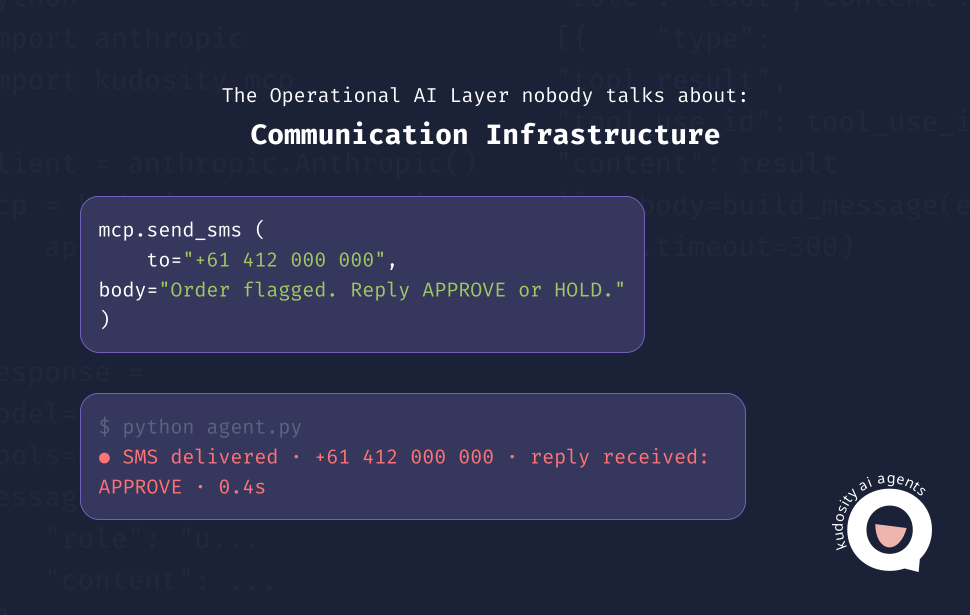
For example, an AI agent approving a refund above a defined threshold may need to escalate the request to a finance lead via SMS before continuing the workflow.
That workflow depends on communication infrastructure.
Developers building Claude-based workflows can also explore the Kudosity Claude integration for operational messaging use cases.
Quick definition: What is AI communication infrastructure?
AI communication infrastructure refers to the messaging, escalation, approval, and coordination systems that allow AI workflows to interact safely and reliably with humans.
MCP connects AI to software. Communication infrastructure connects AI to people.
That distinction matters.
MCP solves a critical problem - standardising how AI systems retrieve context and execute actions across external tools and systems. Operational AI systems still require approvals, escalation paths, delivery visibility, audit trails, fallback handling, and meaningful human oversight at critical decision points.
MCP gives agents the tools to act.
Communication infrastructure gives organisations visibility into what those agents are doing, who has been notified, and when human intervention is required.
Messaging APIs then provide the communication layer required for escalation, approvals, notifications, and delivery visibility.
Why this matters now
Industry analysts are watching this gap closely.
Gartner projects that by 2029, 70% of enterprises will deploy agentic AI as part of IT operations, up from less than 5% in 2025.
As that deployment scales, the need for human oversight infrastructure scales with it.
Operational AI systems require reliable mechanisms for handling uncertainty, escalating irreversible actions, notifying responsible stakeholders, maintaining auditability, and confirming workflow completion.
Without communication infrastructure, those escalation moments become harder to surface reliably and consistently.
The missing layer in most AI communication infrastructure
Most AI infrastructure conversations today focus on models, orchestration, retrieval, tool execution and autonomous workflows.
Operational communication, escalation, and oversight are still comparatively underexplored. However, in production environments, many AI workflows eventually involve human coordination.
That coordination layer has become operational infrastructure for AI systems.
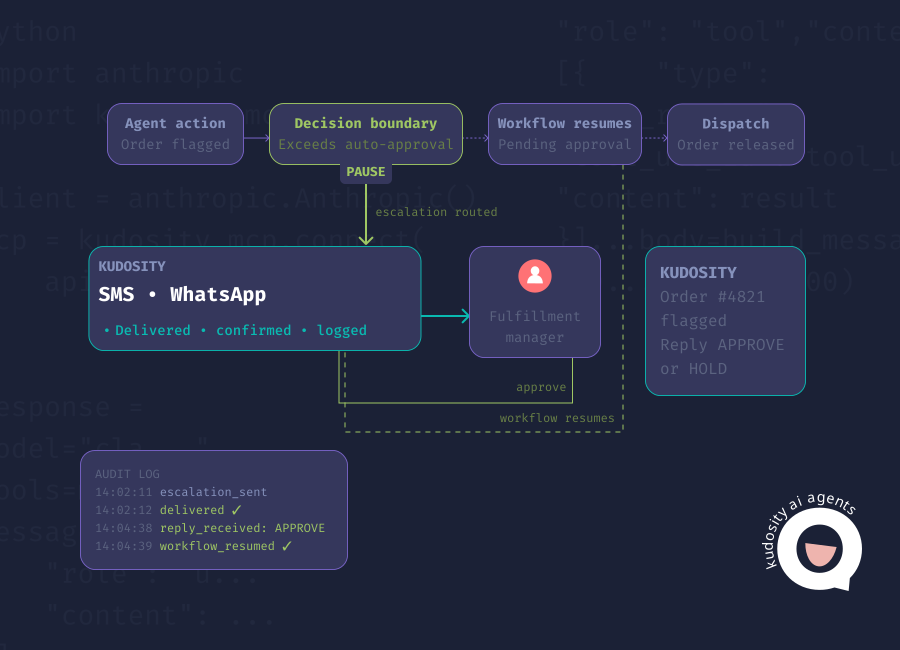
Architecture summary
A production AI workflow typically moves through model reasoning, retrieval and context gathering, workflow orchestration, MCP tooling, communication infrastructure, and human escalation and oversight. Each layer depends on the one before it, but the final two layers, where AI systems communicate with and hand off to humans, are the ones most often underpowered in real deployments.
This layered architecture helps AI systems operate more reliably in production environments.
Human-in-the-loop systems are becoming operational requirements
In practice, many production AI systems still require human oversight and escalation.
Not because AI systems are incapable.
But because operational environments require accountability, approvals, compliance, visibility, escalation handling, and auditability.
This is why human-in-the-loop (HITL) architecture has become a documented requirement for production AI infrastructure.
Major AI platforms including OpenAI now provide dedicated guidance for designing human oversight and intervention workflows in production systems.
AI systems need reliable ways to:
notify humans
request approvals
escalate uncertainty
coordinate decisions
confirm actions
Messaging infrastructure enables that coordination.
Messaging is becoming operational infrastructure
Historically, messaging was treated as:
notifications
APIs
communication channels
delivery systems
But operational AI systems change the role messaging plays.
Messaging increasingly becomes:
escalation infrastructure
approval infrastructure
operational coordination infrastructure
human oversight infrastructure
As AI systems move into real operational workflows, communication reliability becomes increasingly important.
See the SMS and WhatsApp implementation guides for practical examples of operational messaging workflows.
Comparison: MCP vs communication infrastructure
| Capability | MCP | Communication infrastructure |
|---|---|---|
| Tool access | Yes | No |
| Workflow execution | No | Partial |
| Human escalation | No | Yes |
| Approvals | No | Yes |
| Delivery verification | No | Yes |
| Audit visibility | via orchestration layer | Yes |
| Messaging workflows | No | Yes |
| Operational coordination | Partial | Yes |
MCP and communication infrastructure are complementary layers, not alternatives. In practice, a production AI workflow might use MCP to connect an agent to a Shopify store, fraud detection tool, or order management system and Kudosity's communication infrastructure to notify a fulfilment manager via SMS when a high-value order is flagged for review before dispatch.
The operational threshold for AI systems
The threshold between an AI prototype and a production AI system is not compute power or model performance.
It’s whether a human can:
see what the system is doing
intervene when needed
receive escalation notifications
approve critical actions
trust that the right people were informed
That is a communication problem.
And MCP was never designed to solve it.
Communication infrastructure is the layer that closes the gap between AI that can act and AI that organisations can trust.
Explore the Kudosity developer portal
Integrate SMS and MMS into your applications with our flexible API. Our REST SMS API allows seamless integration of SMS capabilities into your applications, whether you're launching a new app or enhancing an existing one.
FAQs
An MCP (Model Context Protocol) server is a component that exposes tools, data sources, and workflows to AI agents through a standardised interface.
Rather than requiring custom integrations for every system, an MCP server allows compatible AI models to connect to external services using a consistent protocol.
MCP was originally developed by Anthropic in 2024 and is now governed under the Linux Foundation’s Agentic AI Foundation.
AI agents operating in production environments frequently reach decision points that require human input, approvals, escalation, or operational oversight.
Communication infrastructure gives AI systems a reliable way to notify, escalate to, and coordinate with the people responsible for governance and intervention.
Human-in-the-loop (HITL) AI is a design approach where humans are embedded into automated workflows at critical decision points.
Rather than allowing AI systems to act autonomously at every stage, HITL systems escalate uncertain, high-risk, or irreversible actions to qualified people for review or approval.
Messaging closes the loop between what AI systems do and what people know.
Delivery-confirmed notifications provide audit trails. Escalation workflows ensure high-risk actions are reviewed. Approval systems help maintain operational control.
Without reliable messaging, AI workflows become harder to govern, monitor, and trust.
Communications infrastructure is the operational layer that enables systems, applications, teams, and customers to exchange information reliably, securely, and at scale.
In modern enterprise environments, communications infrastructure includes messaging, notifications, escalation workflows, delivery visibility, compliance controls, and human-in-the-loop coordination.
Platforms like Kudosity provide communications infrastructure that helps operational AI systems coordinate safely with humans through SMS, WhatsApp, notifications, approvals, escalation workflows, and delivery-confirmed messaging.
As AI systems move into production environments, communications infrastructure becomes critical for operational reliability, governance, visibility, and customer communication.
Get ready for Australia’s SMS Sender ID Registry
From July 2026, Sender ID registration will be required. ACMA’s final steps are still in progress, but Kudosity will keep you informed and help you be ready when registration opens.
:quality(80))
:quality(80))
:quality(80))
:quality(80))