:quality(80))
How to evaluate WhatsApp Business pricing in Australia
Most businesses ask the wrong question about WhatsApp pricing
When evaluating WhatsApp Business providers, many businesses start with a simple question:
"What's your per-message rate?"
It's understandable. Pricing pages are usually built around a single number. But that rarely tells the full story.
The real question is:
What will our actual messaging costs look like once we're live?
The answer depends on several factors, including who you're messaging, what type of messages you're sending, how your customer database is structured, and what happens when a message can't be delivered through WhatsApp.
Understanding those factors before you compare providers can save a lot of surprises later.
This guide explains everything you need to know about WhatsApp for business pricing, including the difference between the free app and the API, how pricing is structured, and the factors that influence WhatsApp costs.
WhatsApp Business App vs WhatsApp Business API
WhatsApp currently provides two main business communication tools:
WhatsApp Business App – A free mobile application ideal for small teams handling conversations manually.
WhatsApp Business API – A scalable, enterprise-ready platform designed for high-volume communication, automation, CRM integration, and multi-agent support.
Kudosity supports WhatsApp Business API, helping businesses streamline messaging, whether you're sending marketing campaigns, service updates, or transactional alerts. It is an API-first platform and does not support the free WhatsApp Business App directly.
Comparison: WhatsApp Business App vs API
| Feature | WhatsApp Business App | WhatsApp Business API (via Kudosity or BSP) |
|---|---|---|
| Pricing | Free | Paid – conversation-based pricing via WhatsApp Business Solution Provider (like Kudosity) |
| Best for | Small businesses, local shops, solo service providers | Medium to large businesses, enterprises, high-volume teams |
| User access | Single-user only | Multi-agent support, unlimited users and devices |
| Automation | Limited (quick replies, greeting/away messages) | Full automation: chatbots, workflows, CRM & marketing tools |
| Message volume | Low to moderate | High-volume messaging across marketing, service, utilities and more |
| CRM / system integration | Not supported | Supported - integrate with platforms like Shopify, Zapier, and Kudosity |
| Messaging types supported | Service and basic marketing (non-template) | Marketing, Service, Utility, Authentication (via Meta templates) |
| Compliance & reporting | Basic (local chat history, simple labels) | Advanced analytics, WABA compliance, regulatory controls |
| Scalability | Limited (single device, single user) | Built for scale across teams, regions, and systems |
| Interactive messages | Limited (basic text, images, quick replies) | Quick-reply buttons, list menus, WhatsApp Flows, rich media |
| Verification badge | Business profile (no green tick) | Verified business account (green checkmark, when approved) |
| Broadcasting | Broadcast lists to limited contacts, no true bulk sends | True bulk campaigns, large-scale broadcasts with templates |
| AI messaging | Not supported | Supported - you can connect your own AI/LLM backends or custom chatbots to WhatsApp via Kudosity’s API |
WhatsApp Business App (Free)
Perfect for small operations, the WhatsApp Business App offers key features at no cost:
Business profile with address, email, website, and description
Quick replies for common messages
Greeting and away messages for automatic responses
Product catalogues to showcase items
Contact labelling and basic customer organisation
Single-user access on one mobile device
If you’re a service provider or independent retailer handling a manageable number of conversations, the free app gives you a direct, reliable way to connect with customers.
WhatsApp Business API pricing (Updated 2026)
The WhatsApp Business API is charged on a conversation-based pricing model. Instead of paying per message, Meta groups messages into 24-hour conversation windows, charged by type:
Marketing – Promotions, re-engagement campaigns, sales offers
Utility – Shipping updates, order confirmations, subscription notices
Authentication – One-time passwords, login verifications, security codes
Service – Customer-initiated chats and support queries
Marketing, Utility, and Authentication conversations are not free and are charged per delivered conversation based on volume, type, and region.
Looking to drive ROI through WhatsApp?
Kudosity’s API integrates seamlessly with the WhatsApp for Business to help you launch high-performing campaigns and workflows with full compliance and control.
Four factors that influence your WhatsApp costs
Most WhatsApp pricing models are shaped by four variables:
Message category
Destination country
SMS failover behaviour
Provider fees and pricing structure
Let's look at each one.
1. Your customer database may not be as Australian as you think
This is one of the most commonly misunderstood parts of WhatsApp pricing.
When WhatsApp calculates message costs, it doesn't look at where your customer lives.
It looks at where their mobile number is registered.
Imagine you're a university, healthcare provider, retailer or hospitality business operating entirely in Australia.
Your customer database looks local.
Your customers transact locally.
Your communications are sent from Australia.
But within that database may be thousands of customers who still use a mobile number registered overseas.
A customer who moved from France ten years ago and never changed their number is priced as France.
A customer working in Sydney on a UK mobile number is priced as the UK.
An international student who arrived recently may be priced according to their home country.
For many Australian organisations, particularly in education, hospitality, healthcare and professional services, this is more common than people expect.
That's why understanding your destination mix is often just as important as understanding your message volume.
Before comparing providers, it's worth asking:
What percentage of our database is internationally registered?
Which countries appear most often?
How would those destinations affect our messaging costs?
A provider should be able to help you understand this before you start sending at scale.
2. The type of message matters
Not all WhatsApp messages are priced the same way.
WhatsApp uses different pricing categories depending on the purpose of the communication.
The four main categories are:
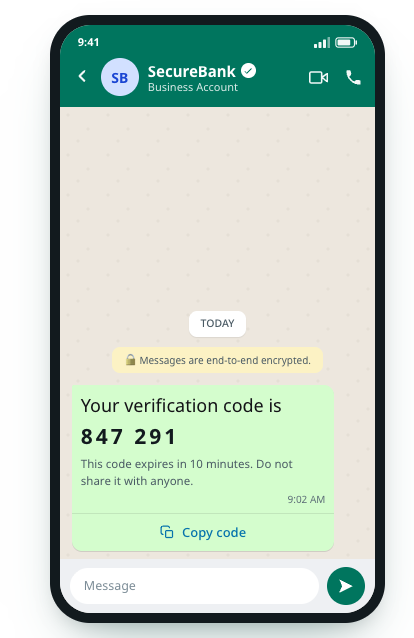
Authentication
Used for security and verification.
Examples:
• One-time passwords (OTPs)
• Login verification
• Account authentication
If most of your messaging falls into this category, reliability and delivery speed are likely to be your biggest priorities.
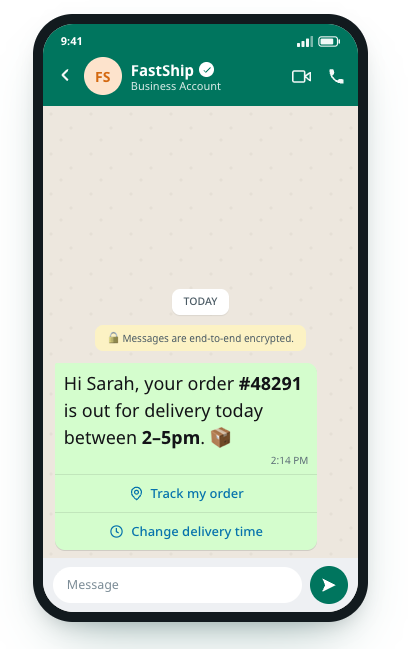
Utility
Used for transactional updates.
Examples:
• Appointment reminders
• Delivery notifications
• Payment confirmations
• Service updates
If you're primarily sending utility messages, the focus is usually workflow completion. A reminder only creates value when the customer actually receives it and acts on it.
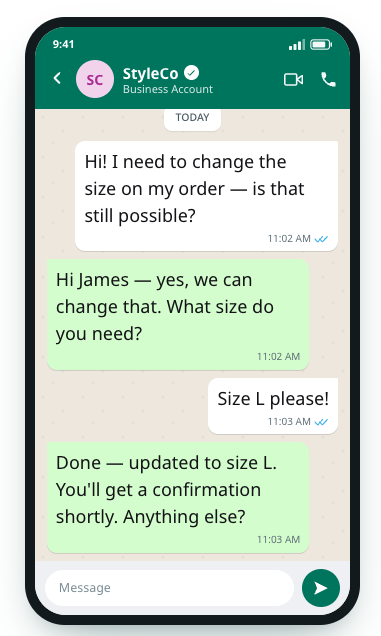
Service
Used during active customer conversations.
Examples:
• Support interactions
• Order enquiries
• Customer assistance
For service messaging, responsiveness and customer experience often matter more than message volume.
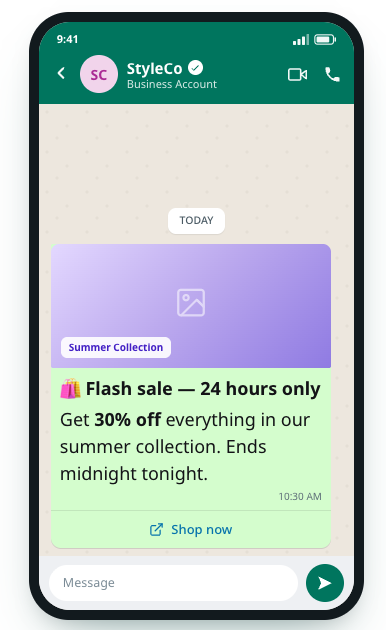
Marketing
Used for promotional communication.
Examples:
• Product launches
• Flash sales
• Loyalty campaigns
• Special offers
If marketing is your primary use case, engagement, reach and campaign performance typically become the key considerations.
The important point is this:
Two businesses sending the same number of messages may have very different costs because they're sending different types of communications.
A useful pricing discussion should always start with understanding what you're actually sending.
3. SMS failover improves reliability, but it can change costs
Not every customer uses WhatsApp.
And even when they do, there are occasions where a WhatsApp message may not be delivered.
That's why many businesses choose to enable SMS failover.
When WhatsApp isn't available, the message automatically falls back to SMS so the customer still receives the communication.
For appointment reminders, authentication codes, delivery notifications and other operational workflows, this can significantly improve completion rates.
But it's important to understand how SMS failover is priced.
The impact depends on:
How many messages fail over
Which countries those SMS messages are sent to
Whether failover is enabled for all workflows or only selected ones
The right approach isn't always to minimise failover.
It's to understand when reliability matters most and ensure the pricing model aligns with your operational requirements.
4. Look beyond the headline rate
The advertised message price is only one part of the picture.
When comparing providers, it's worth understanding whether additional costs apply, including:
Platform fees
Setup or onboarding costs
Template approval fees
Account management charges
Currency conversion exposure
GST treatment
The goal isn't to find the lowest number on a pricing page.
It's to understand what your complete cost model looks like once you're operational.
Five questions to ask any WhatsApp provider
Or are there additional platform, onboarding, template or account fees?
Understanding how failed deliveries are handled can have a meaningful impact on costs.
This is particularly important if you have customers with internationally registered mobile numbers.
Or are costs affected by exchange rate movements?
A simple question that can prevent confusion later. Some overseas providers quote pricing in USD and aren’t especially clear about GST treatment.
A provider should be able to answer these questions clearly and transparently. If obtaining those answers is difficult, it's worth understanding why before you commit.
Focus on the full picture
The best WhatsApp provider isn't necessarily the one with the lowest advertised message rate.
It's the provider that helps you understand:
Your destination mix
Your message categories
Your delivery requirements
Your failover strategy
Your total cost of ownership
Because when pricing reflects how your customers, workflows and communication channels actually behave, there are fewer surprises and better decisions.
Need help modelling your WhatsApp costs?
We'll help you understand:
• Your likely message categories
• Destination mix and country exposure
• SMS failover considerations
• Pricing structure options
• Expected operational costs
So you can compare providers with confidence and choose the model that's right for your business.
:quality(80))
:quality(80))
:quality(80))
:quality(80))
:quality(80))
:quality(80))