Kudosity vs Sinch vs Infobip: MCP SMS servers compared
AI agents are starting to change how developers build and manage messaging workflows.
Instead of only asking an assistant to write code, teams can now connect AI tools to approved systems, documentation and APIs. For SMS, that means an AI agent may be able to find the right endpoint, generate a request, send a message through an approved provider, track delivery and update a workflow.
That is where MCP SMS servers come in.
The important point for Australian businesses is this: MCP support is only one part of the decision. The stronger comparison is what sits behind the MCP layer, including Australian data residency, local compliance, direct carrier relationships, delivery visibility and support.
What is an MCP server for SMS?
An MCP SMS server is a controlled connection between an AI tool and a messaging provider’s APIs.
MCP stands for Model Context Protocol. It is an open standard for connecting AI applications to external tools, systems and data sources. In practical terms, it gives AI assistants a structured way to access approved capabilities instead of relying on custom one-off integrations.
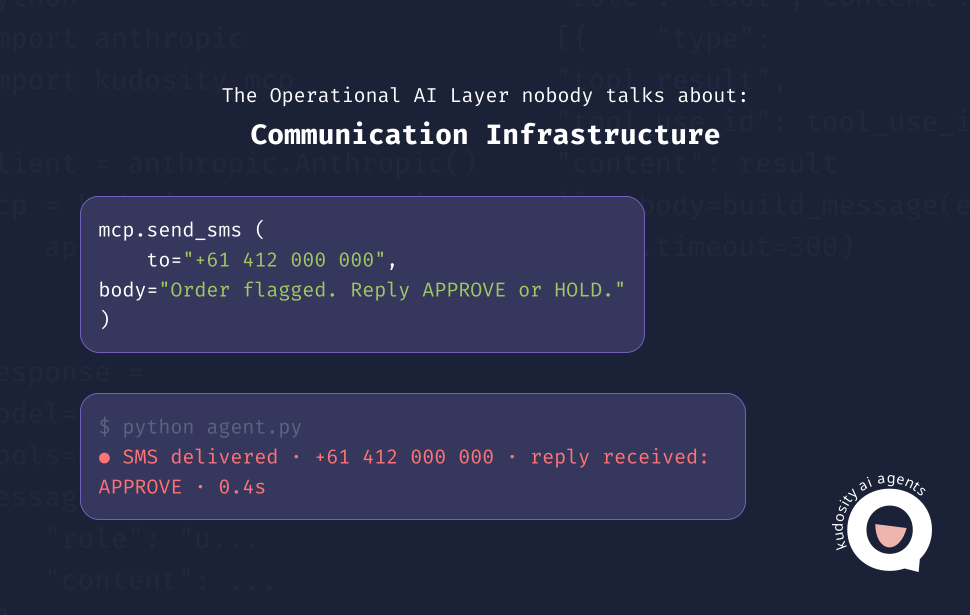
For SMS, an MCP server can expose messaging tools to an AI agent. Depending on how it is configured, that agent may be able to search documentation, inspect API schemas, generate code, send SMS, retrieve delivery reports or update a related system.
The MCP server is not the SMS gateway itself. It is the AI access layer that connects the agent to the provider’s messaging APIs.
Why MCP matters for AI messaging
MCP matters because AI messaging workflows need control.
Without clear permissions, an AI agent connected to customer communication can introduce risk quickly. It needs to know what tools it can use, what data it can access, which actions require approval and how activity is logged.
A typical AI-enabled SMS workflow might look like this:

AI agent
approved MCP or function tool
SMS provider API
delivery report
intent classified
For example, an AI agent could prepare a follow-up SMS after a support interaction, call an approved messaging tool, send through the SMS API, receive a delivery report and update the CRM record.
That sounds simple, but the operating details matter. Consent checks, opt-out handling, sender identity, delivery reporting and audit logs all become more important when AI is involved.
For Australian businesses, commercial SMS also needs to align with ACMA expectations. ACMA states that commercial electronic messages must have consent and include an unsubscribe option, so AI-assisted messaging should not bypass those controls.
Platform comparison
| Area | Kudosity | Sinch | Infobip |
|---|---|---|---|
| Best fit | Australian SMS workflows where local compliance, data residency, direct carrier routing and support matter. | Global enterprise messaging and CPaaS scale across multiple communication channels. | Enterprise omnichannel journeys, automation and global customer engagement. |
| SMS API capability | SMS and broader business messaging APIs, with Australian infrastructure and local delivery context. | SMS REST API, Conversation API and SMPP options for global sending and receiving. | SMS API supports sending, receiving, delivery reports and message logs. |
| AI workflow fit | Strong fit for AI-assisted Australian SMS use cases where the API layer must sit behind local compliance and delivery controls. | Sinch offers an MCP Server in developer preview for agentic communication across services, including messaging, voice and email. | Infobip MCP servers allow AI agents to send messages across SMS, WhatsApp, RCS, Viber and Voice. |
| Australian support | Stronger local fit, with AU and NZ data residency, ACMA compliance and 24/7 local support referenced in pricing materials. | Global platform support, with Australian fit depending on account setup and routing requirements. | Global enterprise support, with Australian fit depending on implementation and regional requirements. |
| Enterprise scale | Built for Australian businesses that need scale without losing local delivery and compliance context. | Strong global CPaaS scale for enterprise teams. | Strong global enterprise omnichannel scale. |
| Omnichannel support | SMS, MMS, WhatsApp, RCS and conversational workflows. | SMS, RCS, WhatsApp, Viber Business, Facebook Messenger and other channels through Conversation API. | SMS, WhatsApp, RCS, Viber, Voice and broader customer engagement capabilities. |
MCP readiness checklist
Before comparing providers, developers should separate MCP presence from MCP readiness.
A platform may have an MCP server, but the workflow still needs to be safe, compliant and useful in production. A practical checklist includes:
Can the platform send SMS through approved API calls?
Can it track delivery status and return delivery reports?
Can it receive replies and pass them back into the workflow?
Can consent and opt-out status be checked before sending?
Can AI-generated messages be logged for audit or review?
Can the workflow connect into a CRM, support platform or internal system?
Can sender identity and routing rules be managed for the market you are sending in?
Can data residency, privacy and security requirements be reviewed before launch?
This is where Kudosity’s Australian positioning becomes important. The advantage is not that MCP alone makes it better. The advantage is that AI-assisted messaging can sit on top of infrastructure designed for Australian business messaging, including AU and NZ data residency, direct carrier routing and ACMA compliance support.
Best use cases by platform
Kudosity
Kudosity is best suited to Australian SMS workflows where messaging needs to be fast, compliant and connected to local delivery infrastructure.
Strong use cases include customer notifications, appointment reminders, service updates, AI-generated follow-up messages, two-way SMS, support workflows and campaigns where delivery tracking matters.
It is also a strong fit for teams that need to assess Australian data residency and local compliance as part of procurement. Kudosity references Australian data centre hosting for API-first infrastructure, along with local privacy and security standards.
Sinch
Sinch is best suited to global enterprise messaging and CPaaS scale.
Its Conversation API supports SMS and other channels, while its developer-preview MCP materials position Sinch for agentic communication workflows across services including, messaging, voice, email and verification.
This makes Sinch a practical option for enterprise teams that need broad global communication infrastructure and already have the internal capability to manage regional compliance, routing and channel strategy.
Infobip
Infobip is best suited to enterprise omnichannel journeys.
Its MCP documentation says AI agents can send messages over SMS, WhatsApp, RCS, Viber and Voice, set up 2FA flows, access customer data and orchestrate multi-tenant workflows with CPaaS X.
This makes Infobip a strong fit for larger businesses building complex customer engagement journeys across multiple markets and channels.
Which platform should Australian teams choose?
For Australian SMS workflows, Kudosity has the clearest local fit.
Sinch and Infobip both have broad global platforms and meaningful AI messaging capabilities. They may be better choices for global enterprise teams that already work across their ecosystems.
But for Australian businesses, the better question is not simply which provider has an MCP server. It is which provider can support the full SMS workflow around it.
That includes:
Australian data residency
ACMA-aligned messaging practices
direct carrier relationships
local support
delivery visibility
consent and opt-out handling
two-way messaging
workflow integration
If those factors matter, Kudosity is the more focused option for AI-assisted SMS in Australia.
Explore the Kudosity developer portal
Integrate SMS and MMS into your applications with our flexible API. Our REST SMS API allows seamless integration of SMS capabilities into your applications, whether you're launching a new app or enhancing an existing one.

FAQs
The best platform depends on the workflow. For Australian SMS workflows, Kudosity is a strong fit because the AI layer can connect into local SMS infrastructure, Australian data residency, ACMA compliance support and direct carrier routing. For global CPaaS or omnichannel programs, Sinch or Infobip may be better suited.
Yes. Sinch has published MCP and AI support materials for communication services, including messaging, voice and email. Infobip also provides MCP servers that allow AI agents to interact with its platform and send messages across channels such as SMS, WhatsApp, RCS and Viber.
Yes. Kudosity is a strong option when the AI agent SMS workflow needs to support Australian delivery, local compliance, data residency and direct carrier routing. This matters for businesses sending customer notifications, reminders, two-way SMS and follow-up messages where governance and delivery visibility are important.
Developers should look for more than the MCP connection itself. The server should expose useful SMS tools, support permissions, allow logging, connect to delivery reports, handle replies and fit into existing workflows. The provider behind it should also support consent checks, opt-out handling, sender management, data security and market-specific compliance.
Get ready for Australia’s SMS Sender ID Registry
From July 2026, Sender ID registration will be required. ACMA’s final steps are still in progress, but Kudosity will keep you informed and help you be ready when registration opens.
:quality(80))
:quality(80))
:quality(80))
:quality(80))